
Mallet Group Lab | Home
Mallet Group
James Mallet and co-workers study evolution, hybridization, and speciation - mainly in butterflies. Methods range from collecting trips in dugouts, field experiments in the Amazon rainforest, population genetic inferences about selection and gene flow, to genomics.
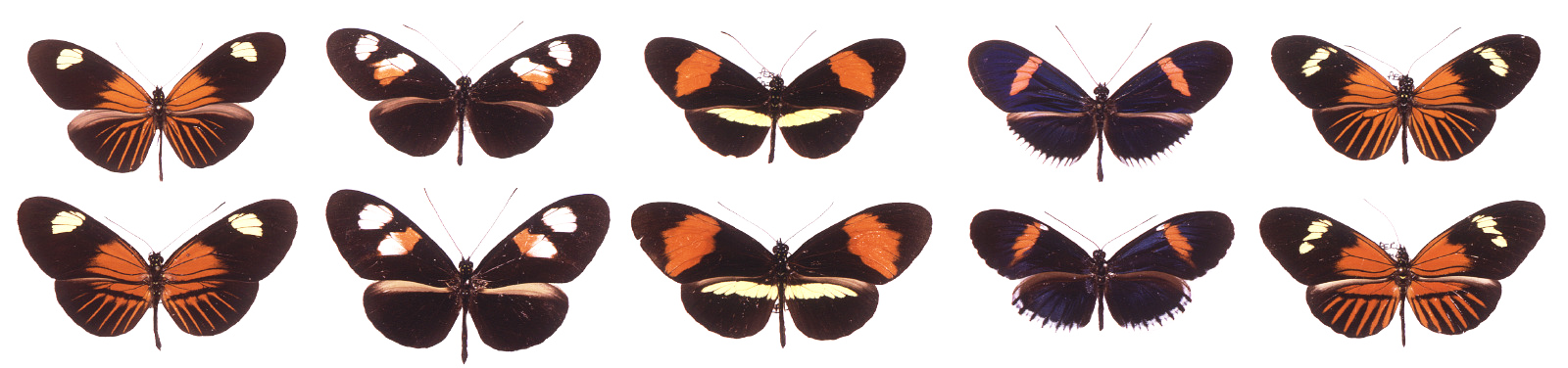
Heliconius erato (above), and H. melpomene (below), a pair of Müllerian co-mimics from different sites in Ecuador and Northern Peru. Each species gains protection from the other's unpalatability. Withinany site, the two species are excellent co-mimics, but major geographic differences in colour pattern have evolved within each species. This geographic diversity is extraordinary by temperate zone standards: the region (about 600km x 300km) of the Andean foothills from which all these forms within each species can be found is less extensive than NewEngland or Great Britain.
Research
Genomics and Speciation
The diversity of life on our planet is generated by the process of speciation, the splitting of a population into two divergent groups that can coexist in a state of nature.

Natural selection, mimicry and speciation
Heliconius are famous for the extraordinary diversity of colour patterns within and between species.

Hybridization and introgression
Many species hybridize with other species, and this can lead to wholesale transfer of variation important in adaptive evolution.

Species concepts and the Taxome Project
The newer understanding we have reached about the genomic nature of species and hybridization is leading to a re-examination of what we mean by the term "species."

History of science
Interest in hybridization and revised species concepts led to a fascination with why others in the past had got it so wrong (in my opinion).

